

People increasingly use ChatGPT, Google AI Overviews, Gemini, Perplexity, Claude, and Microsoft Copilot to research problems, compare products, and decide which businesses to trust. These systems may synthesize an answer and cite only a few sources, so visibility now depends on whether your pages can be found, understood, verified, and selected as evidence.
How do you optimize a website for LLMs and AI search?
There is no guaranteed method for earning an AI citation. The durable strategy combines technical SEO, people-first content, original evidence, clear entities, and trustworthy references. Google says its established SEO practices remain relevant to AI Overviews and AI Mode, while special AI markup and forced content chunking are unnecessary. See Google's generative AI search guidance.
What does optimizing a website for LLMs mean?
LLM optimization is the process of improving how AI-powered discovery systems interact with your website. The goal is to make pages easier to discover, crawl, interpret, retrieve, summarize, verify, and cite. You may also see this work called LLM SEO, AI search optimization, answer engine optimization, or generative engine optimization.
The terminology is still developing. The practical objective is clearer: publish reliable pages that AI search systems can confidently use when answering relevant questions. It extends the foundations covered in our step-by-step on-page SEO guide; it does not replace them.
How AI search visibility works
AI visibility has three connected layers. Discovery asks whether a platform can find and access the page. Selection asks whether the page contains information relevant to the prompt. Citation asks whether the system can confidently attribute a useful claim to that source.
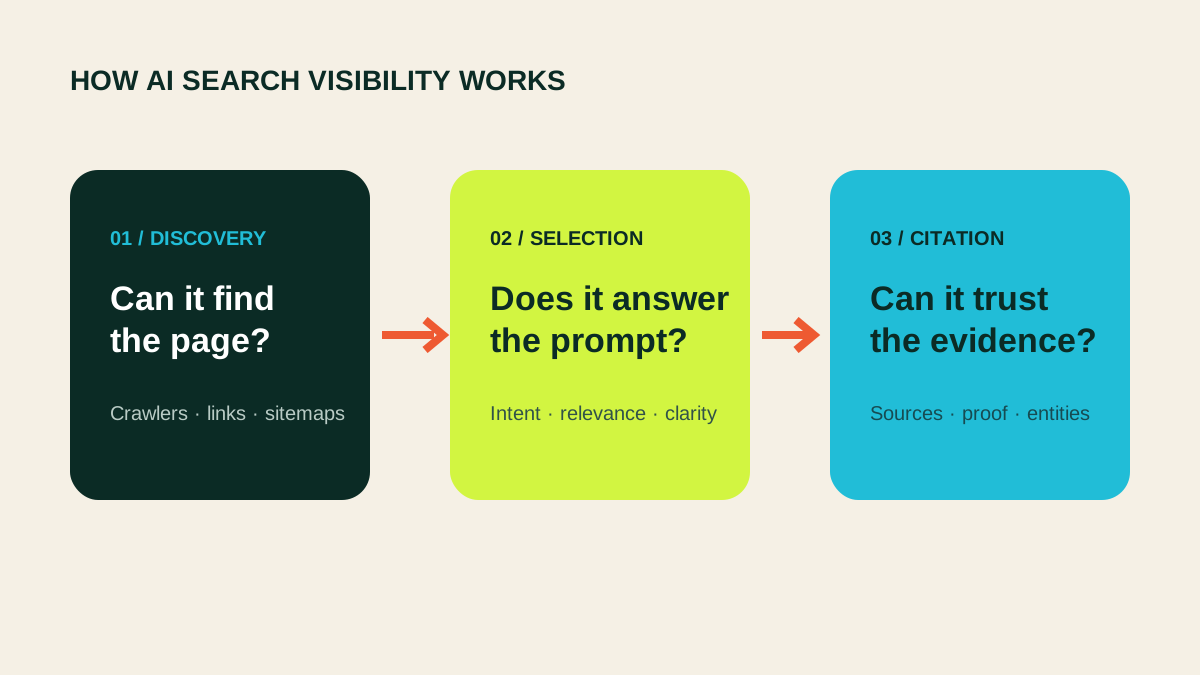
Formatting cannot compensate for a blocked crawler, and crawler access cannot compensate for generic content. Work through the following steps in order.
Can you actually rank in AI search?
Not in the way the phrase suggests, and the difference changes what you should work on.
A search results page has positions. One result is first, another is eighth, and the order is broadly stable for the same query. An AI answer has no positions. It has a handful of sources the model chose to cite, and that set can change between models, sessions, phrasings and locations. There is no position four to climb to.
So "how to rank higher in AI search" is really three separate questions:
- Can the system reach the page? Crawler access, HTTP status, and content that exists without JavaScript.
- Does the page answer the question being asked? Not the keyword: the actual question, in the words a person would use.
- Is there something specific worth citing? An original number, a tested result, a clear definition. Generic summary text gives a model no reason to name you rather than paraphrase.
The third is where most sites lose, and it is the one that cannot be fixed with configuration. A page that only restates what ten other pages say is a page a model can safely ignore, because the same answer is available without attribution.
The practical consequence: measure citation frequency across a stable set of prompts over time, not a position. The rest of this guide covers the work that moves it.
1. Measure your current AI visibility
Begin by establishing a baseline. Create a list of 20 to 30 questions potential customers might ask while discovering, comparing, or selecting a product or service.
For ToolTrace, these questions could include:
- What is the best API for extracting article text?
- How can an AI agent read a webpage?
- Which web scraping API returns Markdown?
- How do I extract metadata from a URL?
- What is a reliable web scraping API for a RAG pipeline?
- Which free tool can inspect the SEO elements of a webpage?
Test the same questions across the AI platforms that matter to your audience. Record whether your brand appears, whether your website is cited, which page receives the citation, which competitors appear, what the answer says about your business, whether that information is accurate, and when the test was performed.
Do not treat one response as a permanent ranking. AI answers can change between models, sessions, locations, and prompt variations. Repeat the same tests over time and look for patterns.
2. Make important pages crawlable
AI search systems cannot reliably use content they cannot access. For every page you want discovered, confirm that:
- The URL is publicly accessible.
- It returns an HTTP
200response. - It is not unintentionally blocked in
robots.txt. - Important content appears in the HTML.
- It does not require a user to sign in.
- It does not require a button click to reveal the main answer.
- Your CDN or firewall does not return a challenge page.
Pay particular attention to JavaScript-heavy websites. Some search systems can render JavaScript, but important content should not depend entirely on client-side rendering. Server-rendering or pre-rendering the main content makes it easier for users and different crawlers to access the page.
Use the free Web Page Scraper to see what readable content a static request can retrieve.
3. Make important pages indexable
Crawlability and indexability are related, but they are not identical. A crawler may access a page while search systems still decide not to index it.
Check that:
- The page does not contain an unintended
noindexdirective. - The canonical URL points to the correct version.
- The page is included in the XML sitemap.
- Internal links point to the canonical URL.
- Duplicate pages are consolidated appropriately.
- The page is useful enough to deserve indexing.
Google says a page must be indexed and eligible to appear with a snippet before it can appear as a supporting link in AI Overviews or AI Mode. There is no separate technical eligibility system for those features. Review Google's documentation for AI features.
4. Allow the AI search crawlers you want to reach your content
Search discovery, user-requested retrieval, and model training can use different agents. Review each documented crawler instead of allowing or blocking every AI-related bot under one assumption.
| Crawler | Main purpose | Decision to review |
|---|---|---|
Googlebot | Google Search and its AI search features | Allow pages you want indexed |
OAI-SearchBot | Finding and surfacing pages in ChatGPT search | Allow pages you want included |
GPTBot | Potential model-training use | Control independently from search |
PerplexityBot | Surfacing and linking sources in Perplexity | Allow pages you want discovered |
Perplexity-User | Fetching pages in response to user requests | Review platform documentation and firewall access |
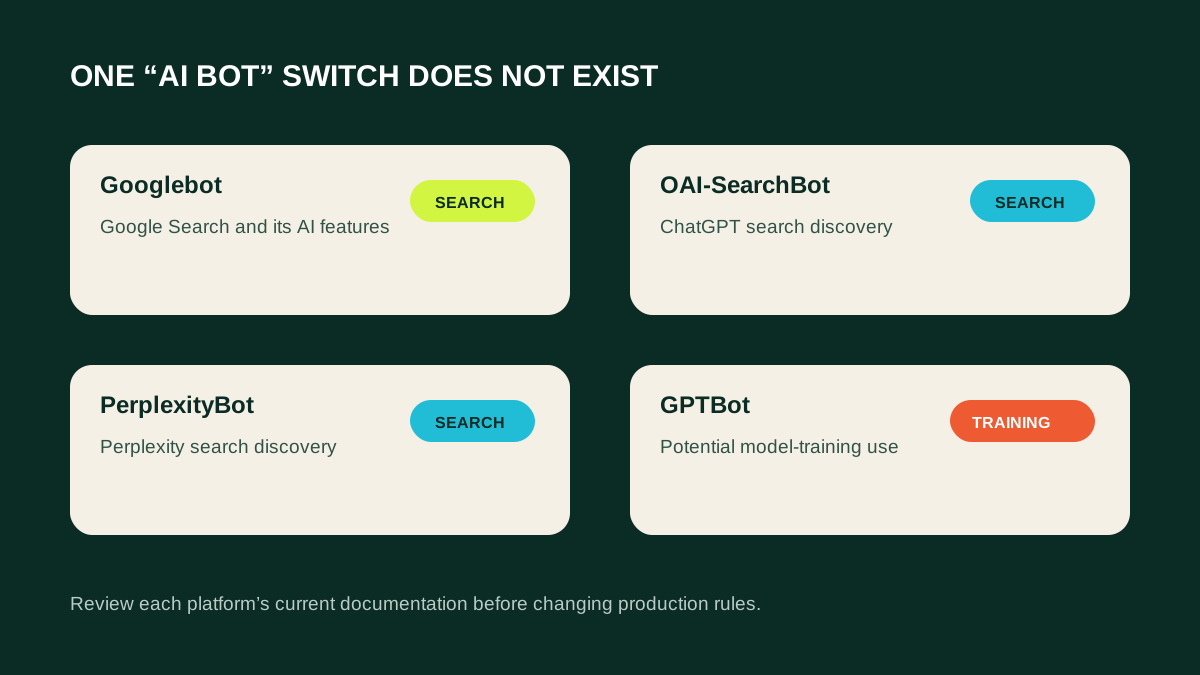
OpenAI recommends allowing OAI-SearchBot if you want pages included in ChatGPT search summaries and snippets. It documents GPTBot separately for potential training use. Read the OpenAI publisher FAQ. Perplexity similarly identifies PerplexityBot as its search crawler in its official crawler documentation.
User-agent: OAI-SearchBot
Allow: /

User-agent: PerplexityBot
Allow: /
Review the complete file before adding rules because broader directives may still block access. Make an independent business decision about training crawlers.
5. Check your firewall and bot protection
Allowing a crawler in robots.txt is not enough if your infrastructure blocks it.
A web application firewall, CDN, security plugin, or bot-management system may return:
- An HTTP
403response - An HTTP
429response - A CAPTCHA
- A JavaScript challenge
- A login page
- An empty HTML response
Test representative pages using the documented crawler information provided by each platform. Avoid disabling security protections globally. Create narrow rules for verified crawler traffic and continue monitoring unusual requests.
6. Maintain an accurate XML sitemap
Your sitemap should include the canonical, indexable pages you want search systems to discover.
Remove URLs that are:
- Redirected
- Duplicated
- Non-canonical
- Blocked
- Deleted
- Intentionally marked
noindex
Update the sitemap when important pages are created or removed. Connect the website to Google Search Console and Bing Webmaster Tools.
For websites that publish or update pages frequently, consider IndexNow. It allows participating search engines to be notified when a URL is published, updated, or deleted. It can improve discovery speed, but it does not guarantee indexing. See Bing's IndexNow documentation and inspect your sitemap with ToolTrace's XML Sitemap Checker.
7. Strengthen your internal linking
Internal links help users and crawlers understand how your pages relate to one another. Link relevant articles to product pages, product pages to documentation, documentation to API references, free tools to related guides, comparison pages to supporting evidence, and older articles to newer resources.
Use descriptive anchor text. “Inspect the page's SEO metadata” gives the destination context that “click here” does not. Important pages should not be orphaned: a crawler should be able to reach them through the normal website structure.
8. Research prompts, not only keywords
Traditional keyword research remains useful, but AI users often ask complete questions containing several requirements.
Compare web scraping API with: “Which API can extract the main article text as clean Markdown for a RAG pipeline?” The second prompt reveals API delivery, main-content extraction, Markdown output, a RAG use case, and a likely developer audience.
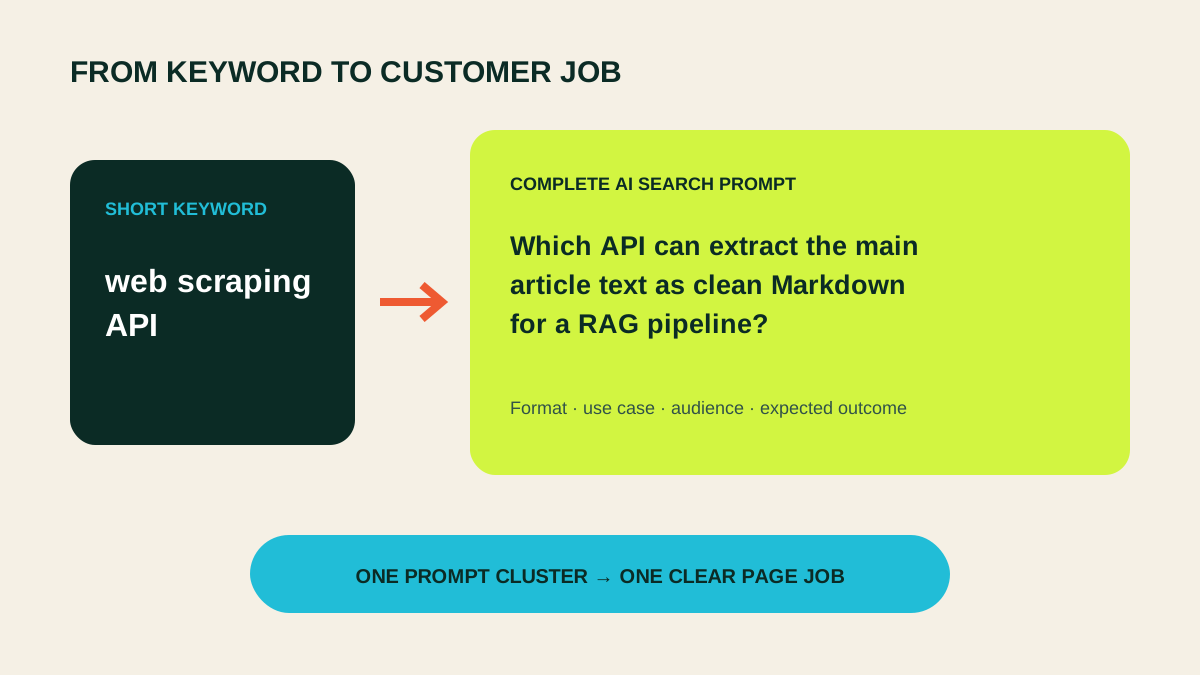
Collect prompts from Search Console queries, customer interviews, sales calls, support tickets, product reviews, community discussions, competitor comparisons, and questions asked before a purchase. Group related prompts by the task the user is trying to complete. One comprehensive page can answer closely related questions; different intentions should normally receive separate pages.
9. Give every page one clear purpose
Every important page should have a job that can be described in one sentence.
Examples include:
- Explain how article extraction works.
- Compare static scraping with browser rendering.
- Help developers select an extraction endpoint.
- Show how to prepare web content for a RAG pipeline.
- Document the response fields returned by an API.
- Diagnose why a public page cannot be scraped.
Avoid combining unrelated topics merely to make a page longer. Focused pages provide clearer evidence about when and why that URL should be retrieved.
10. Put the main answer near the top
After the H1 and a brief introduction, provide the definition, recommendation, or process directly. Do not make visitors cross a long history lesson before receiving useful information.
The rest of the article can explain evidence, exceptions, and implementation details.
11. Use descriptive, self-contained sections
Each section should answer a recognizable question. “Does structured data improve AI search visibility?” is more useful than “Other considerations.”
A weak explanation such as “This is important for several reasons” does not communicate a usable claim. A clear explanation states that structured data can help search engines understand eligible page elements but is not a special requirement for Google's AI features.
A reader should be able to understand an important section without rereading the entire article. This does not mean dividing every paragraph into tiny fragments. Structure content according to the subject and the reader's needs.
12. Add original information competitors cannot reproduce
Generic summaries are easy to produce and difficult to distinguish. Give search and AI systems a reason to cite your page instead of another article covering the same subject.
Useful original material includes:
- First-party research
- Product benchmarks
- Tested workflows
- Real screenshots
- Source code examples
- Before-and-after comparisons
- Expert commentary
- Customer case studies
- Original diagrams
- Failure cases
- Decision frameworks
- Clearly documented product data
For example, ToolTrace could test several extraction methods on the same public article and compare extracted word count, returned HTML size, response time, Markdown quality, navigation removal, and metadata completeness. Explain the test date, methodology, environment, and limitations. A number with a transparent method is more valuable than an unsupported statistic.
13. Make factual claims easy to verify
Content should not merely sound confident. Important claims should be traceable.
When presenting a factual claim:
- Link to the primary source.
- Name the responsible organization.
- Include a publication or review date when freshness matters.
- Explain how original data was collected.
- Separate facts from opinions.
- State relevant limitations.
- Correct outdated information.
Prefer official documentation, standards, laws, research papers, and first-party datasets. Do not add citations only for appearance; the source should support the specific statement next to it.
14. Establish clear brand and product entities
AI systems should not have to guess what your company is or what your product does. Keep the company name, product names, product descriptions, logo, website address, business location, contact details, founder or team information, social profiles, and pricing information consistent.
Review this information across your homepage, About page, product pages, documentation, social profiles, directories, and relevant third-party listings. Write a short factual company description rather than relying on slogans.
For example, “ToolTrace provides web extraction and page-inspection APIs for developers, AI agents, and data workflows” is more informative than a broad statement about transforming the future of technology.
15. Use semantic HTML and descriptive headings
Use familiar HTML elements for their intended purposes:
- One clear page-level heading
- Descriptive section headings
- Paragraphs for explanations
- Ordered lists for sequential processes
- Unordered lists for collections
- Tables for genuine comparisons
- Figures and captions for visual evidence
- Links with descriptive anchor text
You do not need to divide all content into tiny “AI-friendly chunks.” Google says special chunking is not required for generative search, and there is no ideal page length. The content should be as long as necessary to satisfy the audience.
16. Add accurate structured data
Structured data can clarify the meaning of visible page information and make pages eligible for supported search features. Depending on the page, appropriate types may include:
OrganizationSoftwareApplicationProductArticleBreadcrumbListFAQPage
The structured data must match visible content. There is no special AI visibility schema, and structured data does not guarantee an AI citation. Google explicitly advises site owners not to overfocus on schema as a generative search tactic.
Use structured data because it accurately describes the page, then validate it with ToolTrace's Schema Markup Checker.
17. Use images and videos that add evidence
Visuals should explain, demonstrate, compare, or prove something. Useful visuals include real product screenshots, annotated interfaces, original charts, workflow diagrams, comparison tables, short product demonstrations, and before-and-after examples.
For every important image:
- Use a descriptive filename.
- Add accurate alt text.
- Place it near the relevant explanation.
- Include a caption when context is necessary.
- Compress the file.
- Specify its dimensions.
- Avoid embedding important text only inside the image.
Do not force keywords into alt text. Describe what the image shows and why it is useful.
18. Earn legitimate third-party references
A business cannot establish every important claim about itself using only its own website. Independent references can confirm that the business exists, the product serves a recognizable category, customers or experts have used it, and outside experience supports its claims.
Earn relevant references through:
- Original research
- Useful free tools
- Technical documentation
- Open-source projects
- Expert contributions
- Partnerships
- Customer case studies
- Industry publications
- Relevant directories
- Genuine community participation
Avoid fake reviews, mass-produced guest posts, paid link networks, and irrelevant directories. Google warns that inauthentic mentions are not a useful shortcut for generative search.
19. Keep important information current
AI answers may repeat old information if outdated content remains publicly available. Regularly review pages containing prices, product features, API behavior, legal requirements, statistics, team information, integration instructions, comparisons, and recommendations.
Use a genuine “last reviewed” date when freshness matters. Do not update a date without reviewing the content. Check the claims, links, screenshots, examples, structured data, and recommendations. When replacing important information, update related pages so the website does not present conflicting facts.
20. Separate AI search inclusion from model training
A common mistake is treating every AI crawler as if it performs the same job. Search inclusion, user-requested page retrieval, and model training can have separate controls.
OpenAI, for example, documents OAI-SearchBot for ChatGPT search discovery and GPTBot for potential training use. A publisher can therefore make a deliberate decision about each purpose rather than blocking or allowing everything under one assumption.
Document these decisions internally so a future infrastructure or security change does not accidentally reverse them.
21. Treat llms.txt as optional
llms.txt is a proposed text format for directing AI systems toward selected website resources. It may be useful for platforms or tools that explicitly support it.
However:
- It does not replace
robots.txt. - It does not make blocked pages accessible.
- It does not guarantee indexing.
- It does not guarantee citations.
- It is not a substitute for an XML sitemap.
- Google does not use it as a special ranking or inclusion signal.
Treat it as an optional experiment. Prioritize accessible HTML, internal links, accurate sitemaps, useful content, and original evidence first.
22. Measure citations, referrals, and business outcomes
AI visibility is useful only when it contributes to a meaningful business objective.
Track:
- Referral visits from AI platforms
- Pages receiving AI referrals
- Citations for your target prompts
- Brand mentions without links
- Competitors mentioned beside your brand
- Sign-ups
- API registrations
- Demo requests
- Assisted conversions
- Revenue
- Accuracy of generated product descriptions
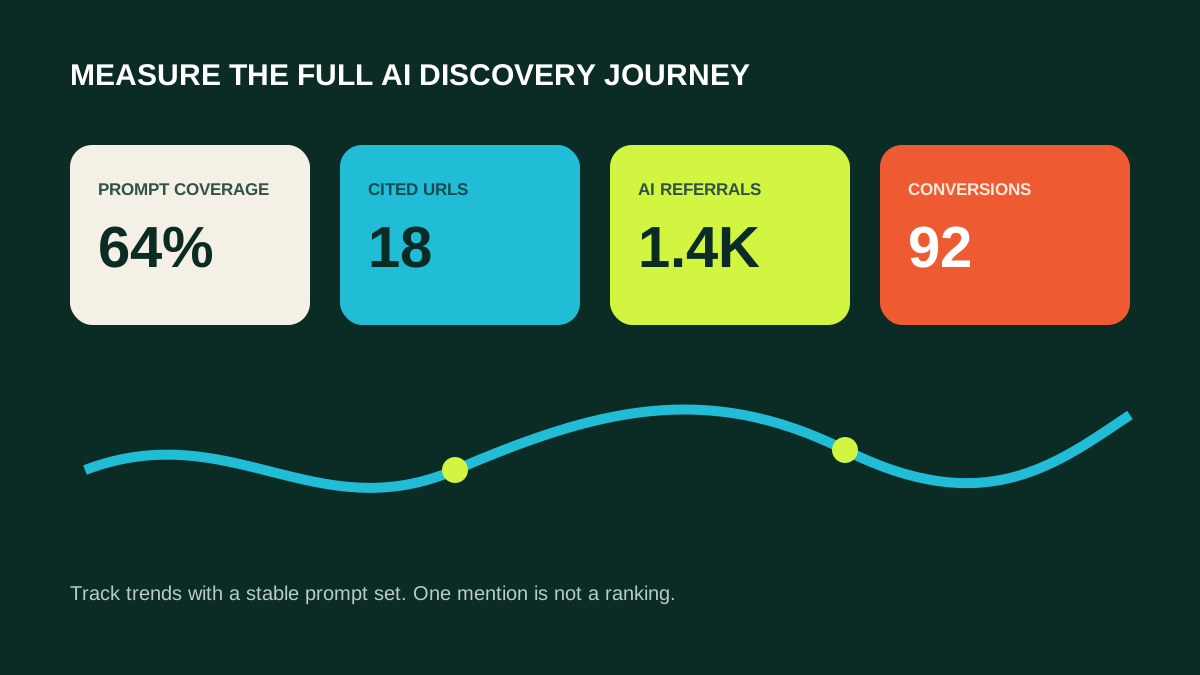
OpenAI states that ChatGPT referral URLs include utm_source=chatgpt.com, allowing this traffic to be identified in analytics. Google includes AI Overviews and AI Mode activity in Search Console's overall Web reporting.
Do not rely on referral traffic alone. Someone may discover your company in an AI answer and later visit directly or perform a branded search. Use a stable prompt set and record trends instead of reacting to one answer.
A practical 30-day AI search optimization plan
Week 1: Technical access
- Audit
robots.txtand crawler permissions. - Check important URLs, canonicals, and indexability.
- Update the sitemap and verify webmaster tools.
- Test CDN and firewall responses.
Week 2: Content and entities
- Build a customer-prompt map.
- Assign prompt groups to clear page jobs.
- Standardize company and product descriptions.
- Add direct answers and remove unsupported claims.
Week 3: Original value
- Publish an original test, comparison, or workflow.
- Add real screenshots and diagrams.
- Document methods, dates, sources, and limitations.
- Identify the author or reviewer.
Week 4: Distribution and measurement
- Submit important updates through relevant search tools.
- Promote original resources to relevant audiences.
- Record baseline prompt results and AI referrals.
- Establish a monthly review schedule.
AI search optimization checklist
Before publishing an important page, confirm that:
- The page has one clear purpose.
- The main answer is visible near the top.
- The content is available without signing in.
- The URL returns HTTP
200. - Crawlers are not unintentionally blocked.
- The canonical URL is correct.
- The page is included in the sitemap.
- Relevant internal links point to the page.
- The title and H1 accurately describe the page.
- Sections use descriptive headings.
- Important claims have credible sources.
- The page includes original value.
- Brand and product names are consistent.
- Structured data matches visible content.
- Images have descriptive alt text.
- The author or reviewer is identified when appropriate.
- The publication or review date is accurate.
- The page has a clear next action.
- AI referrals and citations can be measured.
Common LLM optimization mistakes
Publishing generic AI-generated content
Lightly edited summaries create little reason for another system to cite your page. Use AI to assist research and editing, then add specific expertise, verification, and original value.
Blocking relevant search crawlers
A restrictive crawler rule, CDN, or firewall can prevent discovery even when a page works in a browser.
Confusing search discovery with training
Review each documented user agent separately rather than applying one assumption to every AI-related crawler.
Writing only for machines
Unnatural repetition, forced questions, excessive headings, and disconnected paragraphs make content worse without guaranteeing visibility.
Treating schema as a shortcut
Structured data cannot create authority or originality missing from the visible page.
Publishing unsupported statistics
Provide a primary source or explain how the data was produced.
Tracking only referral traffic
AI discovery may contribute to later branded searches, direct visits, and assisted conversions.
Frequently asked questions
Can I guarantee that ChatGPT will cite my website?
No. Allowing OAI-SearchBot and publishing useful content makes discovery possible, but it does not guarantee a citation for a particular prompt.
Is LLM SEO different from traditional SEO?
It adds crawler-policy, prompt-monitoring, citation-accuracy, and entity-consistency work, but still depends heavily on conventional SEO.
Do I need an llms.txt file?
Not for Google Search or Google's generative features. Treat it as optional for systems that explicitly support it.
Does structured data improve AI visibility?
Accurate schema can clarify page information and support eligible rich results. It is not a special requirement or guarantee for AI citations.
Should I allow GPTBot?
That is a policy decision about potential model training. It is separate from allowing OAI-SearchBot for ChatGPT search discovery.
How long does AI search optimization take?
Technical changes may improve access quickly, but indexing, authority, mentions, and citations develop over time. Measure repeated trends rather than expecting a permanent instant ranking.
What content is most likely to earn AI citations?
Direct answers supported by original evidence, primary sources, specific expertise, and accurate entity information provide useful material to reference.
Can AI search optimization replace SEO?
No. AI search visibility builds on crawlability, indexability, relevance, internal linking, content quality, and authority.
Put the guide into practice
Make your website easier to discover and cite
AI visibility starts with evidence, not shortcuts. Check whether important pages are crawlable, indexable, correctly titled, internally linked, and represented by accurate metadata. Then improve the information those foundations expose.
Inspect a page with the free ToolTrace SEO Page Inspector or explore all free website tools.